Nutraceuticals Third Party Manufacturers in India

Nutraceutical PCD Pharma Company in India
July 3, 2026Softgel Capsule PCD Pharma Company in India
July 13, 2026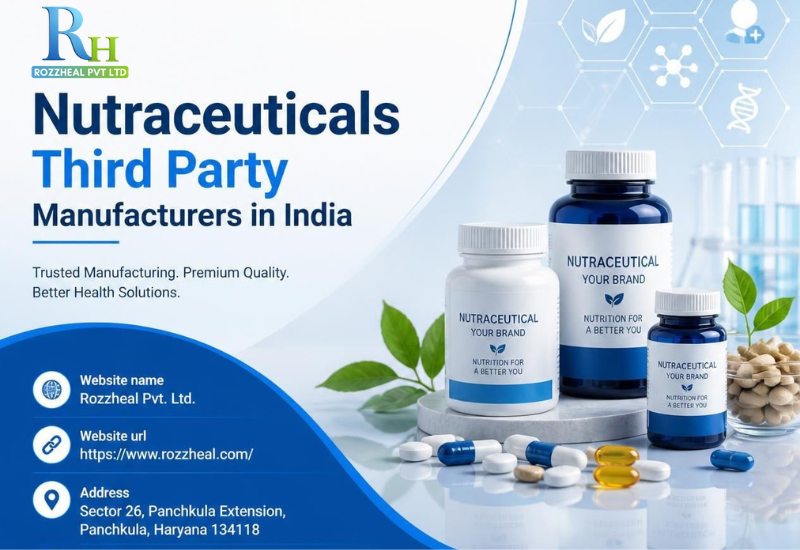
Introduction to Nutraceutical Manufacturing in India
India’s health and wellness industry is changing fast. More people are moving away from treating illness and toward preventing it. Because of this shift, demand for vitamins, herbal supplements, protein blends, and functional foods has grown a lot.Behind almost every supplement bottle, there is a manufacturing partner. This partner formulates, produces, and packs the product. This is where nutraceuticals third party manufacturers in India play a big role. In fact, it’s also why many entrepreneurs now look for a Nutraceutical PCD pharma company in India. This way, they can launch a health brand without building their own factory.
So, this guide covers what you need to know about third party nutraceutical manufacturing in India. First, we’ll look at what it means and why it matters. Then, we’ll explain how the business model works, what to check in a manufacturing partner, and how companies like Rozzheal help entrepreneurs turn ideas into shelf-ready products.
What Is Third Party Nutraceutical Manufacturing?
Third party manufacturing is also called contract manufacturing. In this setup, a brand owner hands over production to an expert manufacturing unit. Meanwhile, the brand owner focuses on marketing and sales. The manufacturer, on the other hand, handles sourcing, production, testing, and packaging. All of this happens under the brand’s own label.
In short, when you partner with nutraceuticals third party manufacturers in India, you get:
- A fully equipped manufacturing unit without owning one
- Access to formulation scientists and R&D teams
- Products made under your own brand name and packaging
- Lower upfront cost and a faster time-to-market
- The freedom to test new products before scaling up
As a result, this model has become the backbone of India’s supplement industry. It lets thousands of small and mid-sized brands compete with big, established players.
Understanding Nutraceuticals: A Quick Overview
Nutraceuticals sit between food and medicine. They include dietary supplements, functional foods, functional drinks, herbal extracts, protein powders, vitamins, minerals, and probiotics. Ayurveda-based wellness products also fall in this group.
Unlike regular medicines, nutraceuticals are usually classified as food products in India and are regulated by the Food Safety and Standards Authority of India (FSSAI). Overall, they combine nutrition with health benefits, making them increasingly popular among health-conscious consumers. People use nutraceutical products to support immunity, weight management, joint health, gut health, and skin health. As demand continues to rise, Nutraceuticals Third Party Manufacturers in India play a vital role in producing safe, high-quality supplements that meet regulatory standards and consumer expectations.
The Growing Size of India’s Nutraceutical Industry
Understanding the size of this industry helps explain the current boom in third-party manufacturing and PCD business models. Indeed, recent research paints a strong growth picture for the sector.
Key Market Statistics for 2026
- Industry estimates for 2026 place the India nutraceuticals market between roughly USD 6–8 billion (on a narrower product basis) and over USD 40 billion when functional foods and drinks are included.
- Most research firms project a yearly growth rate (CAGR) of 10% to 15% through the early 2030s. In other words, this is faster than most mature global markets.
- For example, a 2026 report from CareEdge Ratings valued India’s broader nutraceutical market at around USD 29–30 billion in 2024. It expects this to reach USD 37–38 billion by 2026, and USD 55–57 billion by 2030.
- Functional foods and drinks make up more than half of category sales. This is because Indian shoppers increasingly prefer getting nutrition through everyday food rather than pills.
- The 18–35 age group (Millennials and Gen Z) forms the largest group of buyers. As a result, this group drives demand for protein powders, multivitamins, and beauty supplements.
- Meanwhile, the 35–55 age group is fueling growth in herbal and joint-care products, while the 55+ group is driving demand for bone health and memory support.
- Additionally, online shopping and direct-to-consumer brands are growing fast, thanks to rising internet use and a shift toward buying online.
- Finally, North India currently holds one of the largest regional market shares, mainly due to rising health awareness and lifestyle diseases.
Overall, these numbers explain why demand for nutraceuticals third party manufacturers in India is rising so sharply. Simply put, brands need reliable, scalable, and rule-following partners to keep up with this growth.
Why Entrepreneurs Choose Third Party Manufacturing
Setting up a nutraceutical plant needs heavy spending. It also needs licensing, skilled staff, and ongoing rule-following work. Because of this, most new brands can’t justify the cost early on. That’s why partnering with an established manufacturer often makes more sense.
Here’s why third party manufacturing has become the preferred route:
- Lower upfront cost: No need to buy machines, build a plant, or hire a full production team
- Faster market entry: Products can be formulated and launched in weeks, not years
- Rules handled for you: FSSAI licensing, GMP certification, and quality paperwork are managed by the manufacturer
- Room to grow: Order sizes can grow or shrink based on demand, without extra stress
- Access to expert teams: Manufacturers often employ nutritionists, food technologists, and pharma scientists
- More time for branding and sales: You can focus on marketing and customers instead of production
- A wide product range: From capsules and tablets to powders, syrups, and gummies, most formats are possible
What Is a Nutraceutical PCD Pharma Company in India?
A Nutraceutical PCD pharma company in India works on the Propaganda Cum Distribution (PCD) model. Here, the company gives exclusive distribution rights to individuals or small businesses. These rights usually apply to a specific area. In turn, the PCD company supplies products, marketing materials, and branding support, while the distributor handles local promotion and sales.
This model differs from simple franchising. That’s because a PCD pharma company usually also manufactures the products it distributes, or arranges the manufacturing itself. So, partners typically get:
- Exclusive rights in a defined area
- A full product range, including tablets, capsules, syrups, and sachets
- Marketing tools such as visual aids and product cards
- Good margins and flexible payment terms
- Support with drug licenses and paperwork
For anyone starting a wellness business with limited money, therefore, a Nutraceutical PCD pharma company in India is often the easiest way in. It combines distribution rights with access to ready-made, tested products.
Key Services Offered by Third Party Manufacturers
A dependable manufacturing partner does far more than fill capsules. Their full range of services typically includes:
- Product formulation and R&D — building new formulas based on market trends and health needs
- Raw material sourcing — buying quality, tested ingredients from approved vendors
- Manufacturing across formats — tablets, capsules, powders, syrups, oils, gummies, and functional foods
- Quality checks and testing — microbial testing, stability testing, and heavy metal checks
- Custom packaging and labeling — designing packaging under the client’s own brand
- Rule-following paperwork — FSSAI license support, product registration, and compliance papers
- Private labeling — making and packaging products entirely under the client’s brand name
- Bulk and contract manufacturing — flexible order sizes for startups and established brands
- On-time logistics and delivery — getting finished goods to distributors and retailers on schedule
How to Choose the Right Manufacturing Partner
Not every manufacturer offers the same quality, rule-following, or service. So, before signing an agreement, check these key factors:
- Certifications and licenses: Confirm the manufacturer holds a valid FSSAI license, GMP certification, ISO certification, and HACCP compliance where needed
- Manufacturing setup: Look for modern, automated machines in a clean, well-run facility
- Product range and flexibility: A good partner should offer many formats and shape formulas for your brand
- Quality control steps: Ask about in-house testing labs and batch testing steps
- Turnaround time: Confirm production timelines and delivery schedules up front
- Minimum order quantity (MOQ): Check whether the MOQ fits your business size, especially if you’re just starting out
- Track record and reviews: Look at past client ties and years of experience
- Clear pricing: Make sure there are no hidden costs in formulation, packaging, or shipping
Regulatory Standards: FSSAI, GMP, and Quality Compliance
Nutraceuticals fall under food rules in India. So, following FSSAI standards is a must for every manufacturer. This framework covers ingredient safety, allowed additives, labeling rules, and health claims.
On top of FSSAI compliance, however, good manufacturers usually also hold:
- Good Manufacturing Practices (GMP) certification for standard production steps
- ISO certification for quality management systems
- WHO-GMP compliance, where needed, for manufacturers also making pharma-grade products
- Lab testing for microbial safety, heavy metals, and nutrient strength
In short, this rule-following backbone matters for two reasons: consumer safety and brand trust. Therefore, partnering with a rule-following manufacturer protects your business from legal and trust-related risks later on.
Business Opportunities in India’s Nutraceutical Sector
Given the industry’s fast growth, there’s real opportunity for new entrants. This is especially true through low-cost models like third-party manufacturing and PCD franchising. Some of the biggest opportunity areas include:
- Protein and sports nutrition — a fast-growing area driven by fitness culture and gym memberships
- Immunity and wellness supplements — steady demand following heightened post-pandemic health awareness
- Herbal and Ayurveda-based products — matching India’s cultural love for natural remedies
- Gut health and probiotics — a rising category gaining ground among city shoppers
- Women’s health and hormonal wellness — an underserved area with rising interest
- Geriatric nutrition — bone health and memory support products for India’s aging population
- Children’s nutrition — multivitamin gummies and fortified foods for kids
So, entrepreneurs entering any of these areas through a Nutraceutical PCD pharma company in India can cut their time-to-market. At the same time, they get to rely on proven formulas and manufacturing quality.
Why Rozzheal Is a Trusted Name in Nutraceutical Manufacturing
Among companies in this space, Rozzheal has built a strong name for itself. It combines manufacturing know-how with solid distribution support for its partners. Indeed, businesses entering the wellness space often look for a partner offering full support, from formulation to final packaging, along with clear business terms for PCD franchise partners. As a result, working with an established name like this gives new entrants confidence that their products will meet quality standards while staying competitive on price.
Final Thoughts
India’s nutraceutical industry is entering a period of steady, long-term growth. This is driven by rising health awareness, a growing middle class, and increasing demand for preventive healthcare. As the market continues to expand, entrepreneurs and established wellness brands are choosing to partner with experienced nutraceuticals third party manufacturers in India as a practical, low-risk way to enter this booming industry. Additionally, businesses should ensure their manufacturing partners comply with the quality and safety standards established by the Food Safety and Standards Authority of India (FSSAI), helping build consumer trust and regulatory compliance.
Similarly, working with a trusted Nutraceutical PCD pharma company in India opens the door to exclusive distribution rights, without the burden of setting up your own manufacturing setup.
In the end, whether you’re launching a new supplement brand or expanding an existing one, choosing the right Nutraceuticals Third Party Manufacturers in India is one of the most important decisions you’ll make. A reliable manufacturing partner should offer regulatory compliance, advanced production facilities, consistent product quality, and a proven track record. By partnering with experienced Nutraceuticals Third Party Manufacturers in India, you can ensure long-term business growth, maintain customer trust, and successfully build a competitive nutraceutical brand for years to come.
Frequently Asked Questions (FAQs)
General Business Questions
1. What does a third party nutraceutical manufacturer actually do? They handle the entire production process. This includes formulation, sourcing raw materials, manufacturing, testing, and packaging, all under your own brand name. So, you don’t need to set up your own factory.
2. What is the difference between third party manufacturing and a PCD pharma company? Third party manufacturing focuses only on production under your brand. A PCD pharma company, on the other hand, also grants exclusive distribution rights in a specific area, along with product supply and marketing support.
3. Which nutraceutical products have the highest demand in India right now? Protein supplements, immunity boosters, herbal and Ayurvedic formulas, gut health products, and multivitamins are among the fastest-growing categories today.
4. Can I get my own brand name and packaging on third party manufactured products? Yes. This is called private labeling. The manufacturer produces the product, but it’s packaged and labeled entirely under your brand identity.
Investment and Growth Questions
5. Is it profitable to start a nutraceutical business through third party manufacturing? Yes, mainly because it cuts upfront spending by a lot. Given the industry’s fast yearly growth, many new entrants have built profitable brands with a small initial spend.
6. What is the minimum investment needed to start a nutraceutical PCD business? Investment needs vary by manufacturer and product range. Still, PCD models are usually far cheaper than building your own manufacturing unit. Because of this, they stay open to small business owners and first-time entrepreneurs.
7. How long does it take to launch a product through a third party manufacturer? Timelines vary based on formula complexity and order size. Even so, third party manufacturing generally lets brands go from idea to market much faster than building an in-house facility.
Compliance and Partner Selection Questions
8. What licenses should a nutraceutical manufacturer have? At minimum, an FSSAI license is a must. Good manufacturers also hold GMP certification, ISO certification, and sometimes WHO-GMP compliance for extra quality confidence.
9. Is FSSAI approval enough, or do nutraceutical products need more certifications? FSSAI approval is a must, since nutraceuticals are regulated as food products in India. That said, extra certifications like GMP and ISO further build product trust, though they aren’t always legally required.
10. How do I choose between multiple manufacturing partners? First, compare their certifications, facilities, product range, and quality control steps. Then, check their minimum order quantities, pricing clarity, and client track record before you finalize a partnership.